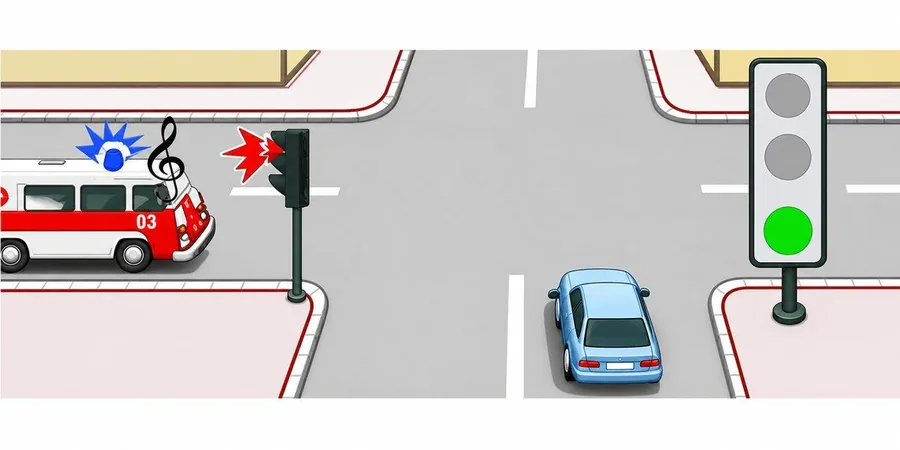
When approaching a stopped vehicle with a flashing red beacon switched on, drivers of vehicles proceeding in that direction must:
-
Stop and continue only after receiving permission.
(Correct answer)
-
Reduce speed so that they can stop immediately if necessary.
-
Continue driving.
When a vehicle with a flashing blue beacon and a special audible signal activated is approaching, drivers of vehicles must:
-
Continue driving.
-
Yield to ensure the unobstructed passage of that vehicle.
(Correct answer)
-
Reduce speed and yield to ensure the unobstructed passage of that vehicle.
Is it mandatory to have the low-beam headlights switched on during daylight hours on mopeds?
-
Mandatory
(Correct answer)
-
Not mandatory
In which case do the rules not require a warning signal to be given?
-
Before stopping at the edge of the roadway.
-
Before a curve in the road within the area of effect of a “Dangerous Turn” sign.
(Correct answer)
-
Before changing to an adjacent traffic lane.
Before changing lanes, a warning signal must be given:
-
Immediately before beginning the maneuver.
-
Immediately after beginning the maneuver.
-
In advance, before beginning the maneuver.
(Correct answer)
When performing a maneuver, a warning signal must be given:
-
Before changing the direction of traffic.
-
While changing the direction of traffic.
-
In advance, before changing the direction of traffic.
(Correct answer)
A warning signal given by hand must be discontinued:
-
Immediately before beginning the maneuver.
(Correct answer)
-
Immediately after completing the maneuver.
-
While performing the maneuver.
In which case must the driver give a warning signal before stopping?
-
If another vehicle is proceeding behind the driver.
-
Only in populated areas.
-
In all cases.
(Correct answer)
If forced to stop on a railroad crossing, what general alarm signal must the driver give by repeated horn signals?
-
Three long and one short.
-
One long and three short.
(Correct answer)
-
One long and two short.
If a turn signal is absent or malfunctioning, a warning signal given by hand must be discontinued:
-
Immediately before beginning the maneuver.
(Correct answer)
-
Immediately after completing the maneuver.
-
While performing the maneuver.
The following combination of horn signals constitutes the general alarm signal given at a railroad crossing:
-
Two long and two short.
-
One long and three short.
(Correct answer)
-
Three long and three short.
-
Three long and one short.
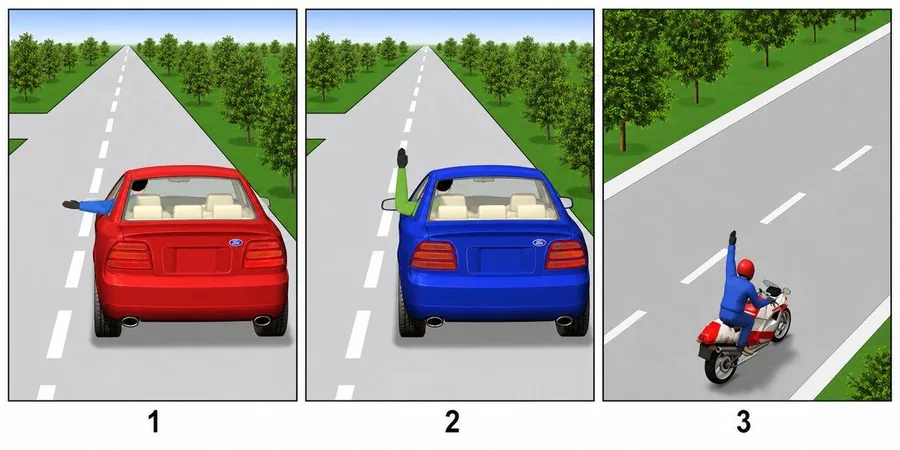
In which image is the driver giving a left-turn signal?
-
1
(Correct answer)
-
2
-
3
When approaching a stationary vehicle with a red flashing beacon activated, drivers proceeding in the same direction must:
-
Stop and continue only after receiving permission.
(Correct answer)
-
Reduce speed so that they can stop immediately if necessary.
For what purpose are orange or yellow flashing beacons installed on vehicles?
-
To obtain right-of-way over other road users.
-
To warn other road users of danger.
(Correct answer)
When a vehicle with a blue flashing beacon and a special audible signal activated is approaching, drivers must:
-
Yield to ensure the unobstructed passage of that vehicle.
(Correct answer)
-
Reduce speed and yield to ensure the unobstructed passage of that vehicle.
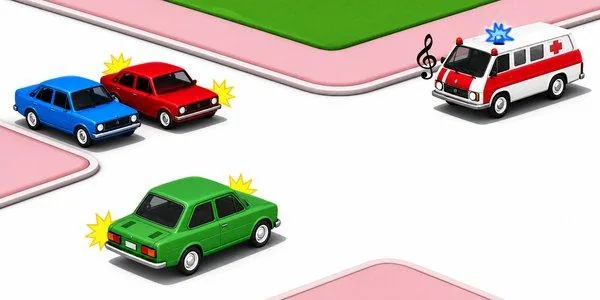
The blue automobile will proceed through the intersection:
-
First, simultaneously with the red automobile.
-
Second, simultaneously with the red automobile.
-
Third, simultaneously with the red automobile.
(Correct answer)
When a vehicle with blue and red flashing beacons and a special audible signal activated is approaching, drivers must:
-
Yield to ensure the unobstructed passage of that vehicle.
-
Reduce speed and yield to ensure the unobstructed passage of that vehicle and the vehicles it is escorting.
(Correct answer)
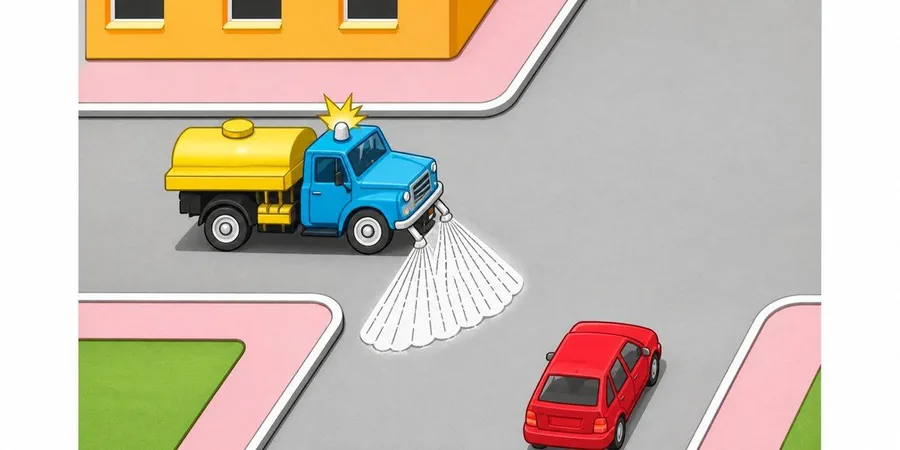
Which vehicle driver has the right-of-way?
-
The driver of the road-cleaning vehicle.
-
The passenger-car driver.
(Correct answer)
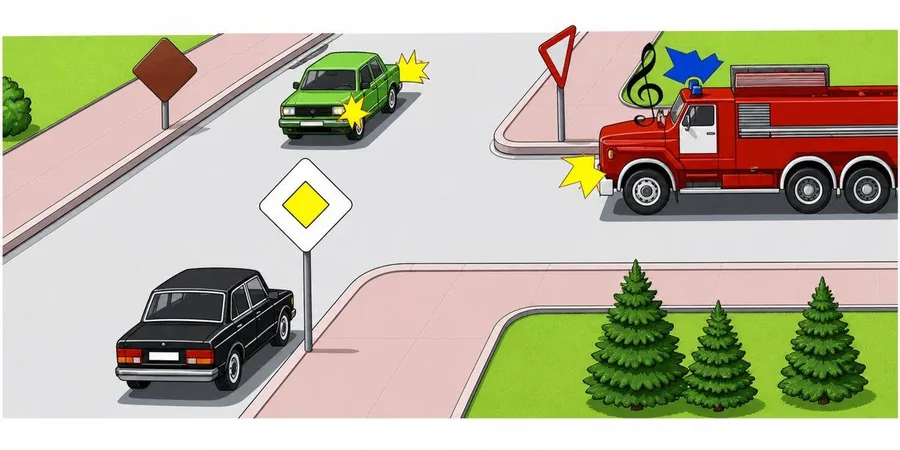
The black automobile will proceed through the intersection:
-
First.
-
Second.
(Correct answer)
-
Last.
Which vehicle driver must yield?
-
The ambulance driver.
-
The passenger-car driver.
(Correct answer)