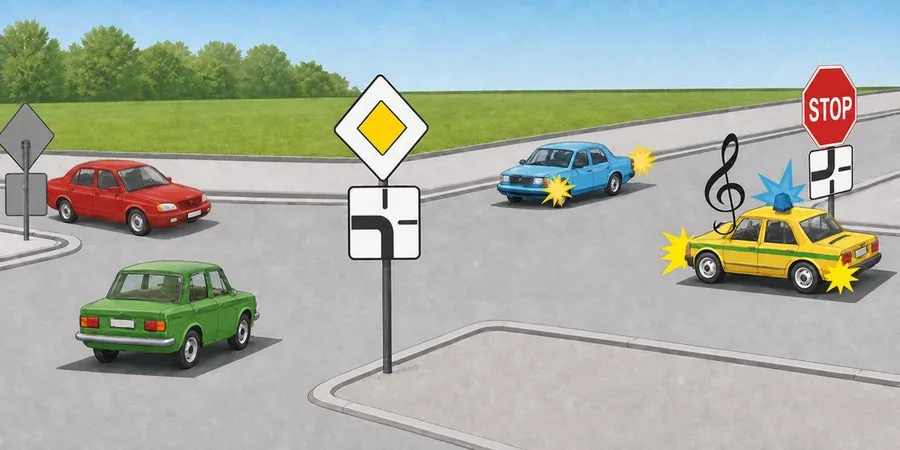
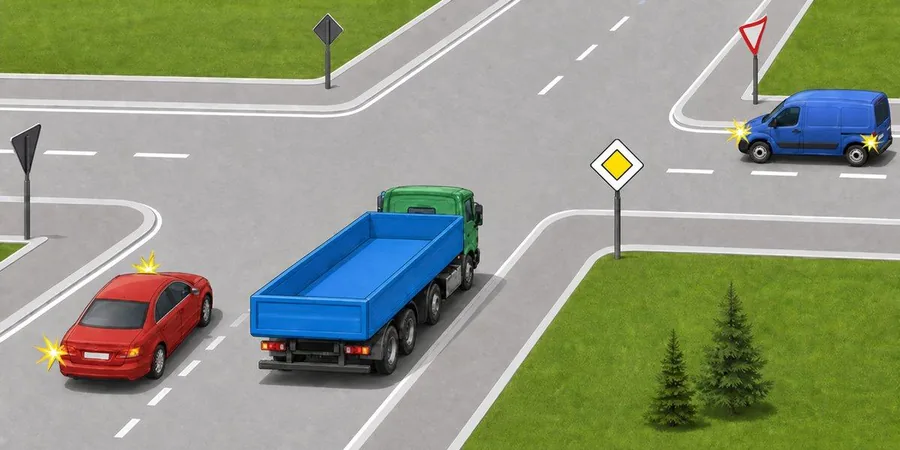
The blue automobile will proceed through the intersection:
-
First.
-
Second.
-
Third.
-
Last.
(Correct answer)
Does an activated yellow (orange) flashing beacon give a vehicle the right-of-way?
-
Yes.
-
No.
(Correct answer)
The driver of a vehicle with white flashing beacons activated gives a special audible signal in order to:
-
Obtain right-of-way over other road users.
-
Attract the attention of police officers and other persons.
(Correct answer)
The driver of a vehicle equipped with a blue flashing beacon has the right-of-way over other road users if the driver:
-
Has activated the flashing beacon.
-
Is giving a special audible signal.
-
Has activated the blue flashing beacon and the special audible signal.
(Correct answer)
Within what distance before a railroad crossing is passing prohibited?
-
Within 50 m before the crossing.
-
Within 100 m before the crossing.
(Correct answer)
-
Within 150 m before the crossing.
Is passing vehicles at an intersection permitted when proceeding on a road that is the priority road relative to the intersecting road?
-
Permitted.
-
Prohibited.
(Correct answer)
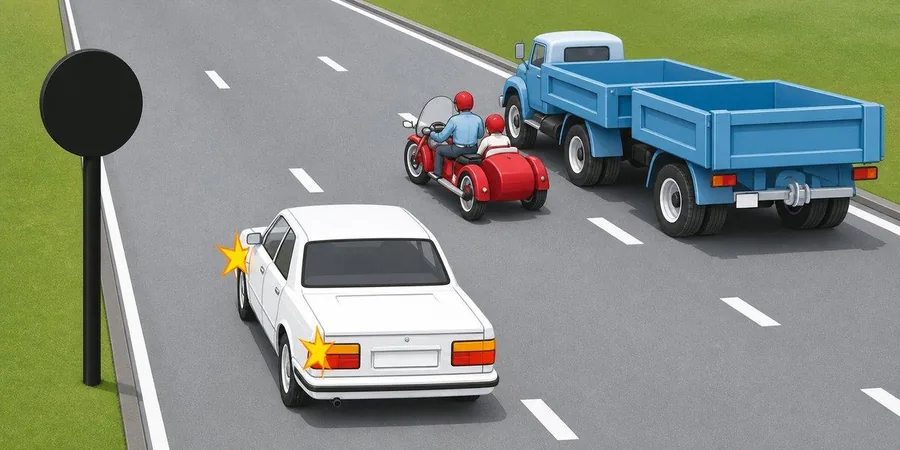
Is the passenger-car driver permitted to pass in the indicated situation?
-
Permitted.
-
Permitted if the motorcycle’s speed does not exceed 30 km/h.
-
Prohibited.
(Correct answer)
Passing is prohibited:
-
At intersections.
(Correct answer)
-
Within 150 m before railroad crossings.
-
In both cases.
Passing is prohibited:
-
At controlled intersections.
-
At uncontrolled intersections.
-
In both cases.
(Correct answer)
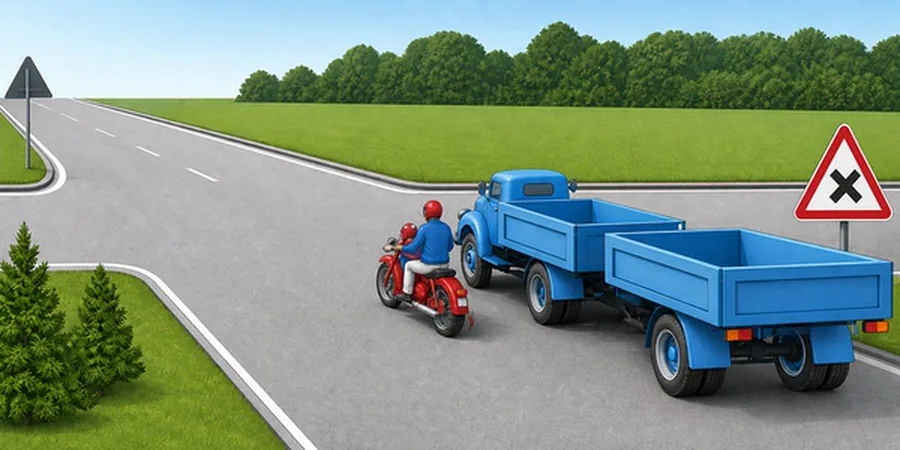
Is it permitted to pass the road train in this situation if its speed does not exceed 30 km/h?
-
Prohibited.
(Correct answer)
-
Permitted.
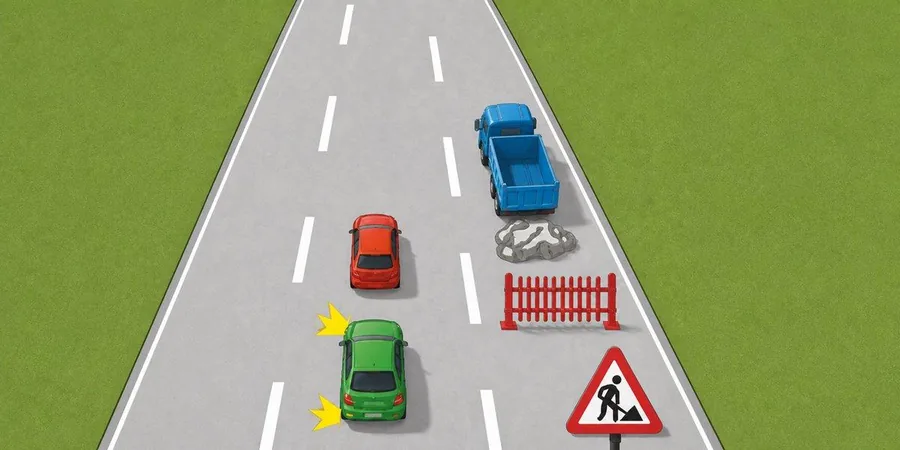
Is the driver of the green automobile permitted to pass?
-
Permitted.
-
Prohibited.
(Correct answer)
-
Permitted if the red automobile is proceeding at a speed below 30 km/h.
Is the driver of the red automobile permitted to pass in this situation?
-
Permitted.
-
Prohibited.
(Correct answer)
-
Permitted if the speed of the automobile being passed does not exceed 30 km/h.
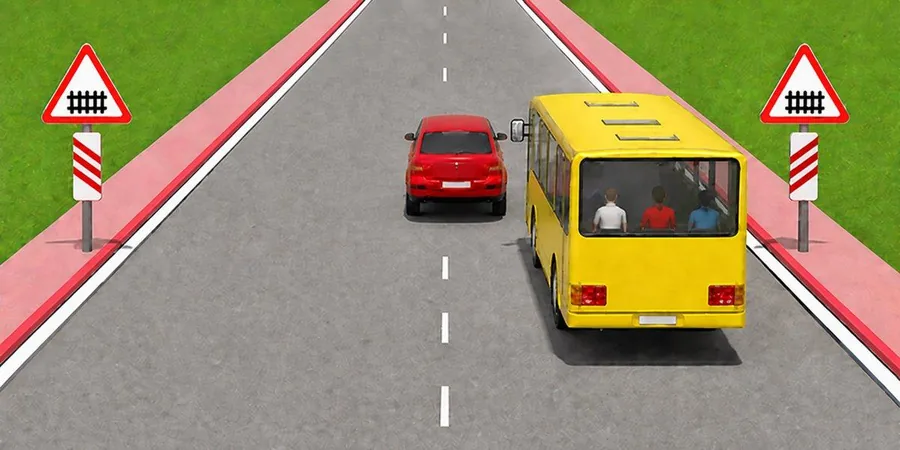
Is it permitted to pass the bus at the indicated location?
-
Permitted.
(Correct answer)
-
Prohibited.
Passing vehicles means:
-
Proceeding ahead of one or more moving vehicles by leaving the occupied lane and entering the oncoming traffic lane.
-
Proceeding ahead of one or more moving vehicles by leaving the occupied lane.
(Correct answer)
At night and under conditions of insufficient visibility, regardless of road lighting, moving motor vehicles must have the following activated:
-
High-beam headlights.
-
Low-beam headlights.
-
High-beam or low-beam headlights.
(Correct answer)
In which case must a motorcycle have its low-beam headlights activated during daylight?
-
When proceeding under conditions of insufficient visibility.
-
When proceeding to a parking location on a motorcycle with a malfunction.
-
In all cases while participating in traffic.
(Correct answer)
-
When carrying an ill passenger.
What must the driver do first if dazzled by the headlights of an oncoming vehicle?
-
Switch the high-beam headlights (if activated) to low beam.
-
Activate the hazard warning lights.
(Correct answer)
-
Give a horn signal consisting of one long and three short signals.
-
Give a horn signal consisting of one short and three long signals.
Horn signals may be used only:
-
In populated areas, to warn other drivers of the intention to pass.
-
When necessary to prevent a traffic accident.
(Correct answer)
-
In both cases.
At night, on unlit sections of road, a moving motor vehicle must have the following activated:
-
High-beam or low-beam headlights.
(Correct answer)
-
Low-beam headlights only.
-
High-beam headlights only.
Rear fog lights may be used:
-
At night when proceeding as part of a convoy.
-
When proceeding through tunnels.
-
Only under conditions of insufficient visibility.
(Correct answer)
-
At night when unloading a vehicle.
-
In all of the listed cases.