Within the permitted limits, what maximum speed should a driver select?
1
A speed that ensures full control of the vehicle.
(Correct answer)
2
The driver may select any speed that does not exceed the maximum permitted speed.
42
A driver is prohibited from:
1
Exceeding the maximum speed specified by the technical characteristics of the vehicle.
2
Exceeding the speed specified by the “Speed Limit” identification sign displayed on the vehicle.
3
Driving at an unnecessarily low speed and thereby impeding the movement of other vehicles.
4
Braking suddenly unless necessary to prevent a traffic accident.
5
All of the above actions.
(Correct answer)
43
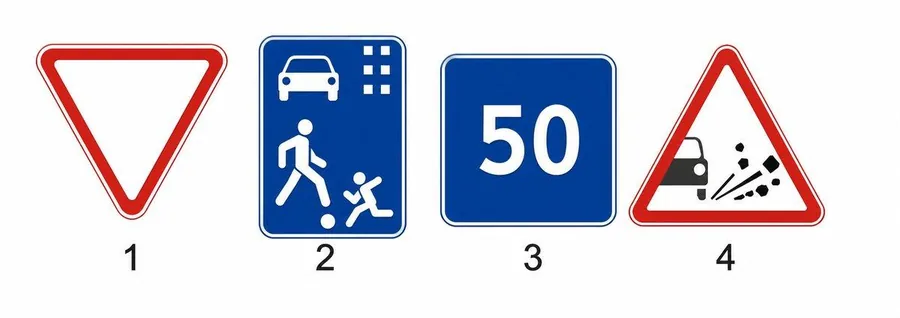
Which sign limits speed?
1
1 and 3.
2
1 and 4.
3
2
(Correct answer)
4
2 and 3.
44
A driver is prohibited from:
1
Crossing a railroad crossing at a speed greater than 30 km/h.
2
Crossing a railroad crossing at a speed below 30 km/h.
3
Proceeding across a railroad crossing, without the permission of the head of the railroad track section, in slow-moving vehicles with a speed below 8 km/h or in tractors coupled to sledges.
(Correct answer)
45
When approaching an intersection, the driver must operate the vehicle at a speed that:
1
Does not exceed the maximum permitted speed established for that road section.
2
Allows the driver to stop and yield to vehicles having the right-of-way.
(Correct answer)
46
A driver is prohibited from increasing speed:
1
If doing so would prevent a driver who is passing from completing the passing maneuver.
(Correct answer)
2
If doing so is necessary to clear the way for a driver who has stopped in order to yield.
3
If doing so is necessary to clear the intersection.
47
A driver must reduce speed:
1
When approaching a vehicle displaying the “Transportation of Children” identification sign while children are boarding or exiting.
2
If blinded.
3
When an obstruction or danger to traffic arises.
4
When approaching a vehicle displaying flashing blue and red beacons and using a special audible signal, as well as when approaching a stationary vehicle displaying flashing blue or flashing blue and red beacons.
5
In all of the above cases.
(Correct answer)
48
If cargo protrudes 0.5 m beyond the side of the vehicle, measured from the outer edge of the marker light, must it be marked during daylight hours with the “Oversized Cargo” identification sign and, at night or under conditions of insufficient visibility, additionally with a white light or reflector at the front and a red light or reflector at the rear?
1
Yes.
(Correct answer)
2
No.
49
A truck whose driver holds a driver’s license for Categories B and C, and which meets the requirements for transporting people in a truck, may carry up to:
1
8 passengers.
(Correct answer)
2
9 passengers.
3
4 passengers.
50
It is prohibited to transport children under 12 years of age:
1
In the cargo bed of a truck with sideboards.
(Correct answer)
2
In the enclosed cargo body of a truck.
51
If cargo protrudes 1.2 m beyond the rear end of the vehicle, must it be marked during daylight hours with the “Oversized Cargo” identification sign and, at night or under conditions of insufficient visibility, additionally with a white light or reflector at the front and a red light or reflector at the rear?
1
Yes.
(Correct answer)
2
No.
52
Transportation of cargo is prohibited if the cargo:
1
Restricts the driver’s field of vision.
2
Makes the vehicle difficult to control or reduces its stability.
3
Obscures exterior lights or reflectors, license plates, or identification signs, or prevents hand signals from being seen.
4
In all of the above cases.
(Correct answer)
53
If the condition or placement of the cargo does not allow it to be transported in compliance with the rules, the driver must:
1
Deliver the cargo safely to the nearest unloading location.
2
Correct the violations or stop proceeding.
(Correct answer)
54
If cargo protrudes 0.6 m beyond the rear end of the vehicle, must it be marked during daylight hours with the “Oversized Cargo” identification sign and, at night or under conditions of insufficient visibility, additionally with a white light or reflector at the front and a red light or reflector at the rear?
1
Yes.
2
No.
(Correct answer)
55
If cargo protrudes 0.3 m beyond the side of the vehicle, measured from the outer edge of the marker light, must it be marked during daylight hours with the “Oversized Cargo” identification sign and, at night or under conditions of insufficient visibility, additionally with a white light or reflector at the front and a red light or reflector at the rear?