At what distance from the vehicle must the emergency warning triangle be placed?
1
At least 15 m in populated areas and at least 30 m outside populated areas.
(Correct answer)
2
At least 10 m in populated areas and at least 20 m outside populated areas.
3
At least 5 m in populated areas and at least 10 m outside populated areas.
42
The hazard warning lights on a vehicle must be activated:
1
If the driver is dazzled by headlights.
2
During towing, on the towed motor vehicle.
3
In both cases.
(Correct answer)
43
The hazard warning lights on a vehicle must be activated:
1
In the event of a traffic accident.
2
During towing, on the towed motor vehicle.
3
In both cases.
(Correct answer)
44
In developed areas where the entrance and exit are marked by the “Residential Zone” and “End of Residential Zone” traffic signs, the following is not prohibited:
1
Pedestrians proceeding on the roadway.
(Correct answer)
2
Through traffic of vehicles.
3
Driving instruction.
45
An intersection is considered controlled if the order of traffic is determined by:
1
Traffic signals only.
2
Traffic controller signals only.
3
Either of the above.
(Correct answer)
46
On an unpaved dirt road, does the presence of a paved section immediately before an intersection make that road equal in priority to the intersecting road?
1
No.
(Correct answer)
2
Yes.
47
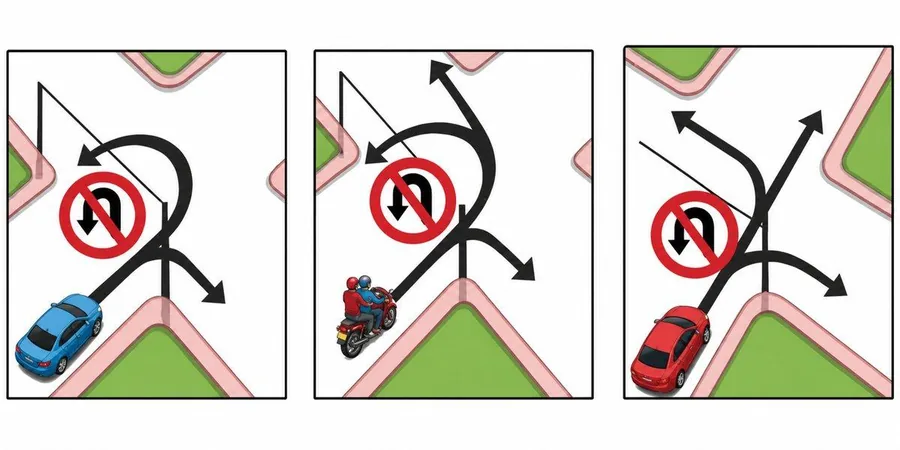
Which image shows the permitted directions of traffic?
1
The left image.
2
The center image.
3
The right image.
(Correct answer)
4
The center and right images.
48
If the meanings of the traffic signals conflict with the requirements of the priority signs, drivers must follow:
1
The requirements of the signs.
2
The traffic signals.
(Correct answer)
49
Is the driver permitted to continue when the yellow traffic signal turns on or the traffic controller raises an arm?
1
Prohibited.
2
Permitted if the driver cannot stop without sudden braking.
(Correct answer)
50
A traffic controller gives a whistle signal:
1
Only when requiring a vehicle to stop.
2
To attract the attention of road users.
(Correct answer)
51
In which case do the rules not require the bus driver to give a warning signal?
1
Before stopping at the edge of the roadway.
2
Before a curve in the road within the area of effect of a “Dangerous Turn” sign.
(Correct answer)
3
Before changing to an adjacent traffic lane.
52
Before changing lanes, the bus driver must give a warning signal:
1
Immediately before beginning the maneuver.
2
Immediately after beginning the maneuver.
3
In advance, before beginning the maneuver.
(Correct answer)
4
Not required if the bus is operating on an established route.
53
If forced to stop on a railroad crossing, what general alarm signal must the bus driver give by repeated horn signals?
1
Three long and one short.
2
One long and three short.
(Correct answer)
3
One long and two short.
4
Two long and two short.
54
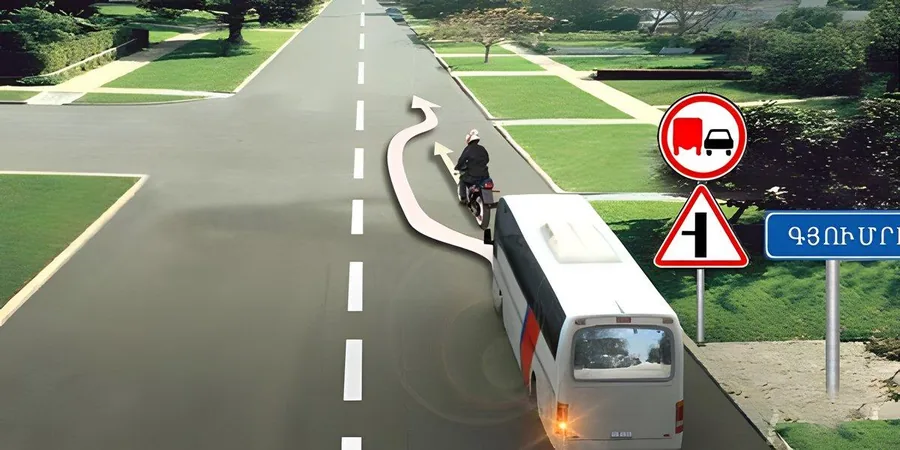
Is the driver of an intercity bus permitted to pass a motorcycle proceeding at a speed of 70 km/h?
1
No.
(Correct answer)
2
Yes.
55
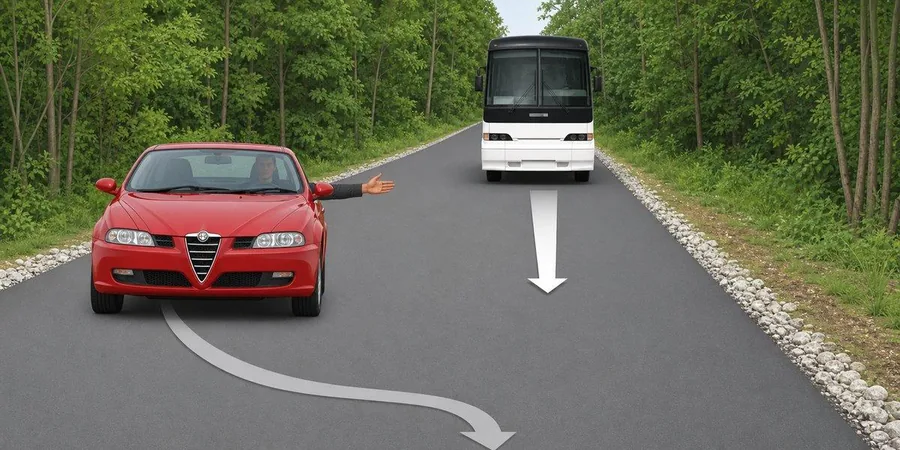
May a warning signal be given by hand in order to proceed along the indicated path?
1
Yes, if the turn signal is malfunctioning.
(Correct answer)
2
Yes, if the turn signal is malfunctioning during daylight hours.
3
Yes, in all cases.
56
Must the driver activate the turn signal before starting to move in a residential zone?
1
No.
2
Yes.
(Correct answer)
3
Yes, if other vehicles are present.
57
To obtain right-of-way over other road users, the driver of a patrol vehicle must activate:
1
The blue flashing beacon.
2
The blue and red flashing beacons.
3
The blue flashing beacon and the special audible signal.
(Correct answer)
58
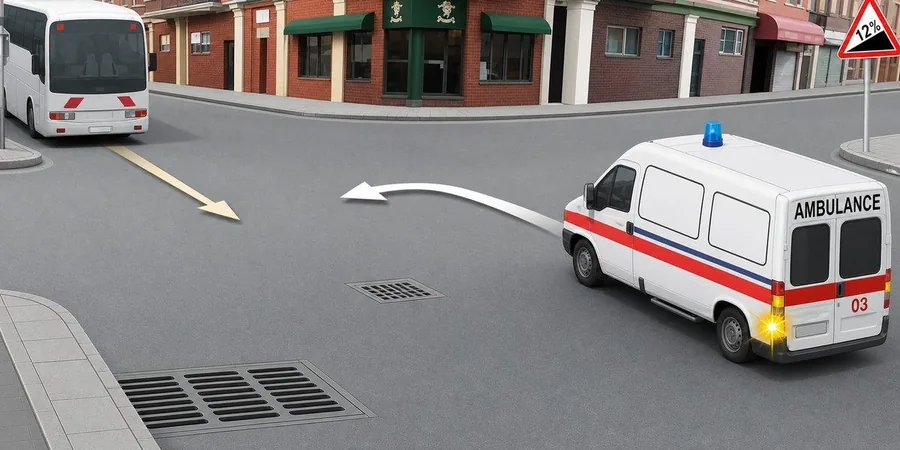
Must the bus driver yield to the ambulance if the blue flashing beacon and special audible signal are not activated?
1
Yes.
2
No.
(Correct answer)
59
Passing is prohibited:
1
At railroad crossings and within 100 m before them.
(Correct answer)
2
At railroad crossings and within 150 m before them.
3
At railroad crossings and within 250 m before them.
60
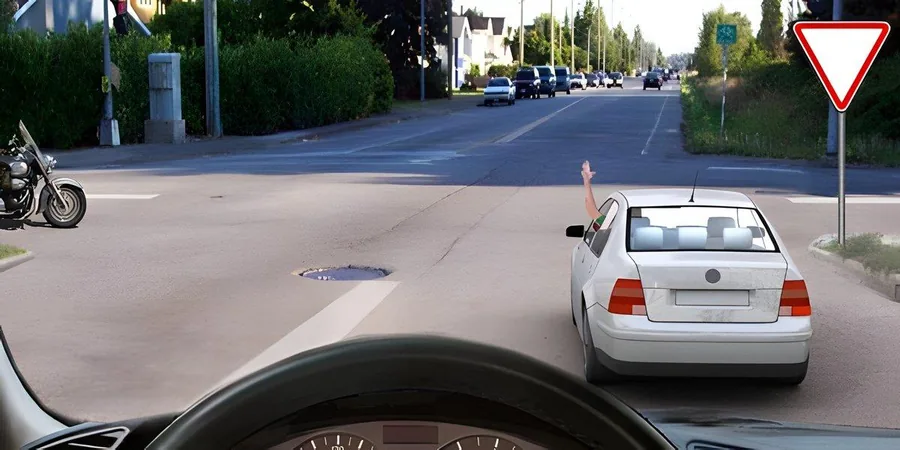
What does the hand signal given by the passenger-car driver indicate?