The driver of a vehicle equipped with a blue flashing beacon has the right-of-way over other road users if the driver:
-
Has activated the flashing beacon.
-
Is giving a special audible signal.
-
Has activated the blue flashing beacon and the special audible signal.
(Correct answer)
Within what distance before a railroad crossing is passing prohibited?
-
Within 50 m before the crossing.
-
Within 100 m before the crossing.
(Correct answer)
-
Within 150 m before the crossing.
Is passing vehicles at an intersection permitted when proceeding on a road that is the priority road relative to the intersecting road?
-
Permitted.
-
Prohibited.
(Correct answer)
Passing is prohibited:
-
At intersections.
(Correct answer)
-
Within 150 m before railroad crossings.
-
In both cases.
Passing is prohibited:
-
At controlled intersections.
-
At uncontrolled intersections.
-
In both cases.
(Correct answer)
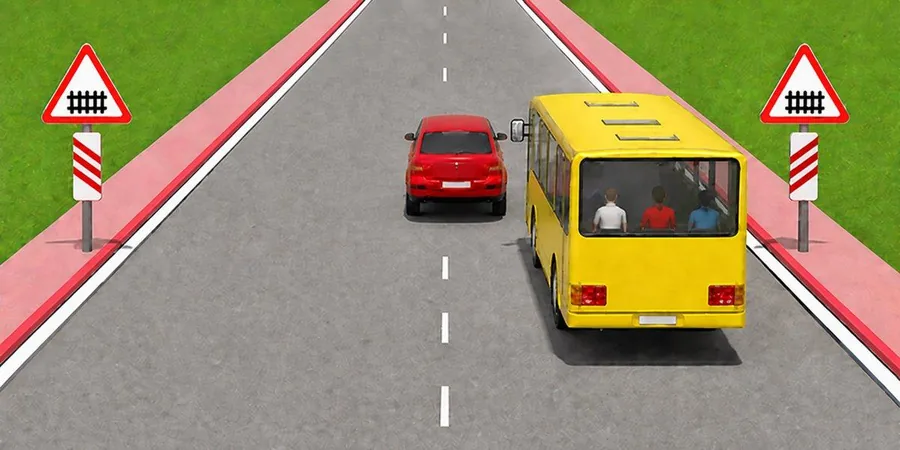
Is it permitted to pass the bus at the indicated location?
-
Permitted.
(Correct answer)
-
Prohibited.
Passing vehicles means:
-
Proceeding ahead of one or more moving vehicles by leaving the occupied lane and entering the oncoming traffic lane.
-
Proceeding ahead of one or more moving vehicles by leaving the occupied lane.
(Correct answer)
At night and under conditions of insufficient visibility, regardless of road lighting, moving motor vehicles must have the following activated:
-
High-beam headlights.
-
Low-beam headlights.
-
High-beam or low-beam headlights.
(Correct answer)
What should the driver do if dazzled by the headlights of an oncoming vehicle?
-
Switch from high-beam headlights (if switched on) to low beam.
-
Switch on the hazard warning lights and, without changing the traffic lane, reduce speed and, if necessary, stop.
(Correct answer)
-
Sound the horn with one long and three short signals.
-
Sound the horn with one short and three long signals.
Horn signals may be used only:
-
In populated areas, to warn other drivers of the intention to pass.
-
When necessary to prevent a traffic accident.
(Correct answer)
-
In both cases.
At night, on unlit sections of road, a moving motor vehicle must have the following activated:
-
High-beam or low-beam headlights.
(Correct answer)
-
Low-beam headlights only.
-
High-beam headlights only.
Rear fog lights may be used:
-
At night when proceeding as part of a convoy.
-
When proceeding through tunnels.
-
Only under conditions of insufficient visibility.
(Correct answer)
-
At night when unloading a vehicle.
-
In all of the listed cases.
At what distance from an oncoming vehicle must high-beam headlights be switched to low beam?
-
At least 100 m.
-
At least 150 m.
(Correct answer)
-
At least 300 m.
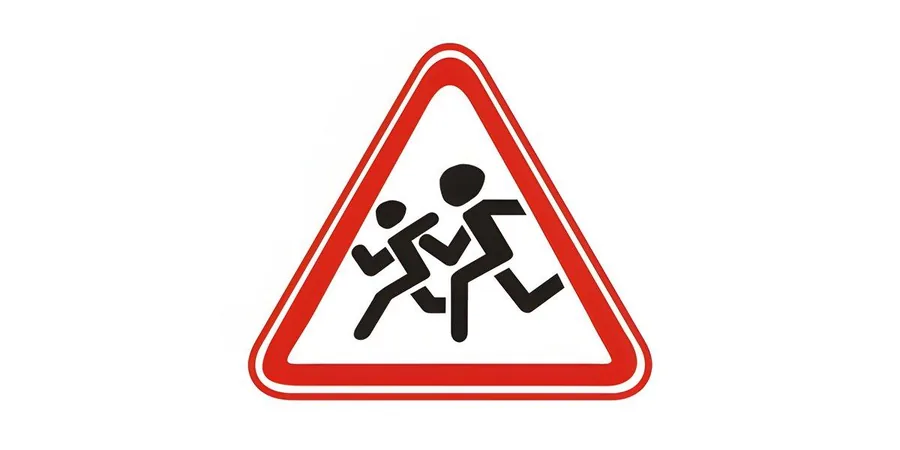
In populated areas, at what distance before the beginning of a hazardous section is this warning sign installed?
-
25–50 m.
-
50–100 m.
(Correct answer)
-
100–150 m.
Where is it permitted to cross railway tracks?
-
At locations where visibility in both directions is at least 1,000 m.
-
At locations most convenient at the driver’s discretion.
-
At designated places only — at railway crossings.
(Correct answer)
-
At a distance of at least 1000 m from railway stations.
What must the driver follow when approaching a railroad crossing?
-
The position of the barrier gate and the traffic signals.
-
The requirements of traffic signs and pavement markings.
-
The instructions of the railroad crossing attendant.
-
All of the listed requirements.
(Correct answer)
Are pedestrians permitted to proceed on a road marked with the “Freeway” sign?
-
Prohibited.
(Correct answer)
-
Permitted outside populated areas, against the direction of vehicle traffic.
-
Permitted outside populated areas, in the same direction as vehicle traffic.
Vehicles whose speed, because of their technical characteristics or condition, does not exceed 40 km/h are:
-
Permitted on freeways only in the rightmost lane.
-
Prohibited from proceeding on freeways.
(Correct answer)
-
Permitted on freeways if there is no “Minimum Speed Limit” sign.
The hazard warning lights on a vehicle must be activated:
-
In the event of a traffic accident.
-
In the event of a forced stop where stopping is prohibited.
-
In both cases.
(Correct answer)
The hazard warning lights on a vehicle must be activated:
-
In the event of a traffic accident.
-
During towing, on the towed motor vehicle.
-
In the event of a forced stop where stopping is prohibited.
-
In all of the listed cases.
(Correct answer)