When approaching a stopped vehicle with a flashing red beacon activated, drivers of public transit vehicles proceeding in that direction must:
1
Stop and continue only after receiving permission.
(Correct answer)
2
Reduce speed so that they can stop immediately if necessary.
3
Continue because they are operating on an established route.
2
When a vehicle with a flashing blue beacon and a special audible signal activated is approaching, drivers of public transit vehicles must:
1
Continue because they are operating on an established route.
2
Yield to ensure the unobstructed passage of that vehicle.
(Correct answer)
3
Reduce speed and yield to ensure the unobstructed passage of that vehicle.
3
Horn signals may be used by drivers of public transit vehicles:
1
To gain an advantage over other road users.
2
In populated areas, to warn other drivers of the intention to pass.
3
When necessary to prevent a traffic accident.
(Correct answer)
4
In all cases.
4
At night, on unlit sections of road, a bus operating on an established route must have the following activated:
1
Low-beam headlights only.
2
High-beam headlights only.
3
High-beam or low-beam headlights.
(Correct answer)
5
During daylight hours, must public transit vehicles proceeding in a specially designated lane opposite the main traffic flow have their low-beam headlights on?
1
Yes.
(Correct answer)
2
No.
6
In which case do the rules not require a warning signal to be given?
1
Before stopping at the edge of the roadway.
2
Before a curve in the road within the area of effect of a “Dangerous Turn” sign.
(Correct answer)
3
Before changing to an adjacent traffic lane.
7
Before changing lanes, a warning signal must be given:
1
Immediately before beginning the maneuver.
2
Immediately after beginning the maneuver.
3
In advance, before beginning the maneuver.
(Correct answer)
8
When performing a maneuver, a warning signal must be given:
1
Before changing the direction of traffic.
2
While changing the direction of traffic.
3
In advance, before changing the direction of traffic.
(Correct answer)
9
In which case must the driver give a warning signal before stopping?
1
If another vehicle is proceeding behind the driver.
2
Only in populated areas.
3
In all cases.
(Correct answer)
10
If forced to stop on a railroad crossing, what general alarm signal must the driver give by repeated horn signals?
1
Three long and one short.
2
One long and three short.
(Correct answer)
3
One long and two short.
11
If a turn signal is absent or malfunctioning, a warning signal given by hand must be discontinued:
1
Immediately before beginning the maneuver.
(Correct answer)
2
Immediately after completing the maneuver.
3
While performing the maneuver.
12
The following combination of horn signals constitutes the general alarm signal given at a railroad crossing:
1
Two long and two short.
2
One long and three short.
(Correct answer)
3
Three long and three short.
4
Three long and one short.
13
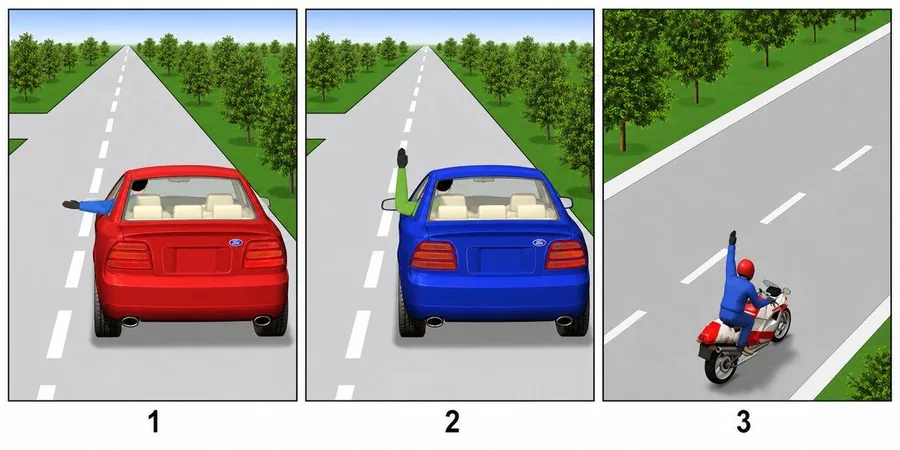
In which image is the driver giving a left-turn signal?
1
1
(Correct answer)
2
2
3
3
14
When approaching a stationary vehicle with a red flashing beacon activated, drivers proceeding in the same direction must:
1
Stop and continue only after receiving permission.
(Correct answer)
2
Reduce speed so that they can stop immediately if necessary.
15
For what purpose are orange or yellow flashing beacons installed on vehicles?
1
To obtain right-of-way over other road users.
2
To warn other road users of danger.
(Correct answer)
16
When a vehicle with a blue flashing beacon and a special audible signal activated is approaching, drivers must:
1
Yield to ensure the unobstructed passage of that vehicle.
(Correct answer)
2
Reduce speed and yield to ensure the unobstructed passage of that vehicle.
17
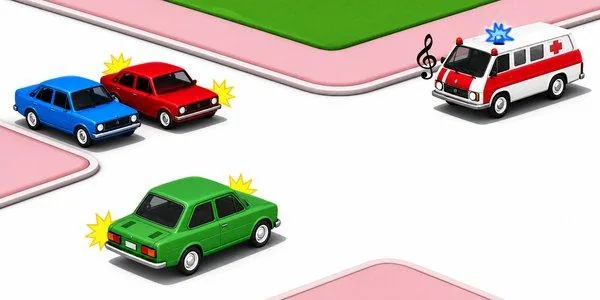
The blue automobile will proceed through the intersection:
1
First, simultaneously with the red automobile.
2
Second, simultaneously with the red automobile.
3
Third, simultaneously with the red automobile.
(Correct answer)
18
When a vehicle with blue and red flashing beacons and a special audible signal activated is approaching, drivers must:
1
Yield to ensure the unobstructed passage of that vehicle.
2
Reduce speed and yield to ensure the unobstructed passage of that vehicle and the vehicles it is escorting.
(Correct answer)
19
Does an activated yellow (orange) flashing beacon give a vehicle the right-of-way?
1
Yes.
2
No.
(Correct answer)
20
The driver of a vehicle with white flashing beacons activated gives a special audible signal in order to:
1
Obtain right-of-way over other road users.
2
Attract the attention of police officers and other persons.
(Correct answer)