1
Permitted if the bus is equipped with modern anti-lock braking (ABS) and other braking-assistance systems.
2
Permitted in any situation if the driver has activated the hazard warning lights in advance.
3
Permitted only when necessary to prevent a road traffic crash.
(Correct answer)
4
Not permitted.
162
What must a bus driver do if congestion has formed beyond a pedestrian crossing and would force the bus to stop on the crossing?
1
The driver is prohibited from entering the pedestrian crossing and must stop before it.
(Correct answer)
2
The driver may stop on the crossing if the traffic signal is still permissive, while yielding to all pedestrians crossing it.
3
In both cases.
163
Is a bus driver permitted to enter a pedestrian crossing if congestion beyond it would force the bus to stop on the crossing?
1
Permitted if the bus is a fixed-route bus approaching a stop.
2
Prohibited; the driver must stop before the pedestrian crossing.
(Correct answer)
3
Permitted if there are no pedestrians.
164
How must a bus driver act at a signal-controlled pedestrian crossing after the traffic signal changes to a permissive signal?
1
Begin moving immediately because pedestrians are prohibited from entering the crossing when the signal is permissive for vehicles.
2
Allow pedestrians to finish crossing the roadway in their chosen direction and only then continue driving.
(Correct answer)
165
How must a bus driver act at a signal-controlled pedestrian crossing after the traffic signal changes to a permissive signal?
1
Begin moving while sounding the horn so that pedestrians speed up or turn back.
2
Allow pedestrians to finish crossing the roadway in their chosen direction and only then continue driving.
(Correct answer)
166
How must a bus driver act when approaching an uncontrolled pedestrian crossing?
1
Yield to pedestrians who are in the bus’s traffic lane.
2
Must not interfere with pedestrians crossing the roadway.
(Correct answer)
167
If a vehicle has slowed down or stopped before an uncontrolled pedestrian crossing, the driver of a bus proceeding in the adjacent lane may continue:
1
If there are no pedestrians in the bus’s lane.
2
Only after sounding the horn.
3
Only after making sure that there are no pedestrians in front of that vehicle.
(Correct answer)
4
In all of the listed cases.
168
Where is a bus permitted to cross railroad tracks?
1
At any location where the rails do not interfere with the bus’s movement and no train is visible.
2
Only at railroad crossings, yielding to the train.
(Correct answer)
169
Is a bus driver permitted to enter a railroad crossing if the red traffic signal is flashing but the barrier is still open?
1
Permitted if no approaching train is visible.
2
Permitted until the barrier begins to lower.
3
Prohibited.
(Correct answer)
170
Is a bus driver permitted to enter a railroad crossing if congestion has formed beyond it?
1
Permitted only for fixed-route buses.
2
Prohibited if this would force the driver to stop on the crossing.
(Correct answer)
3
Permitted if the driver is sure the crossing can be cleared before a train approaches.
171
Is a bus driver permitted to go around vehicles stopped before a railroad crossing if the driver does not enter the oncoming traffic lane?
1
Permitted.
(Correct answer)
2
Prohibited.
172
According to the traffic rules, what is prohibited for a bus driver when traveling on a motorway?
1
Reversing.
2
Driving instruction.
3
Both are prohibited.
(Correct answer)
173
In which direction may a tram proceed if the traffic controller’s arms are extended to the sides or lowered and the tram approaches from the controller’s right or left side?
1
Straight ahead and to the right.
2
Straight ahead only.
(Correct answer)
3
In all directions.
174
In which direction may a tram proceed if the traffic controller’s right arm is extended forward and the tram approaches from the controller’s left side?
1
To the left only.
(Correct answer)
2
In all directions.
3
Straight ahead and to the left.
175
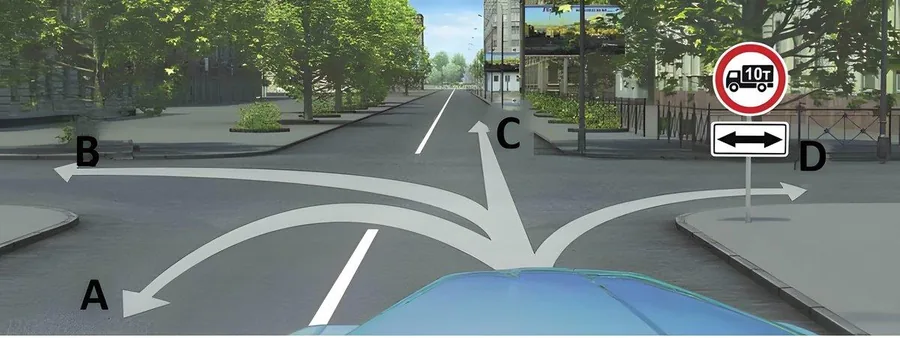
In which directions may a bus with a maximum authorized mass of 12 metric tons proceed?
1
Only C.
2
A and C.
3
All directions.
(Correct answer)
176
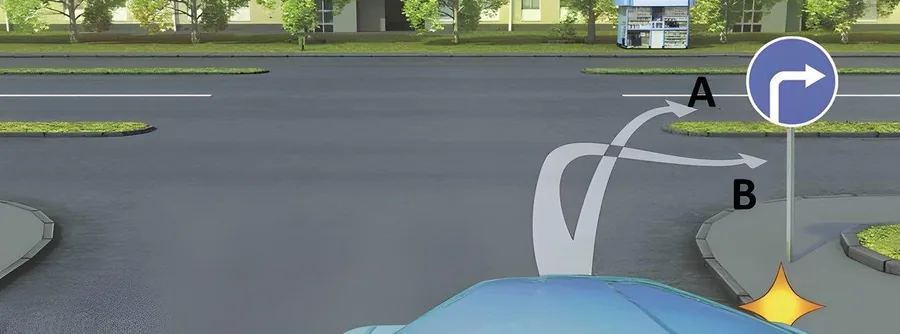
Considering the vehicle’s large dimensions, the driver is permitted to proceed:
1
Along both paths.
2
Only along path A.
3
Only along path B.
(Correct answer)
177
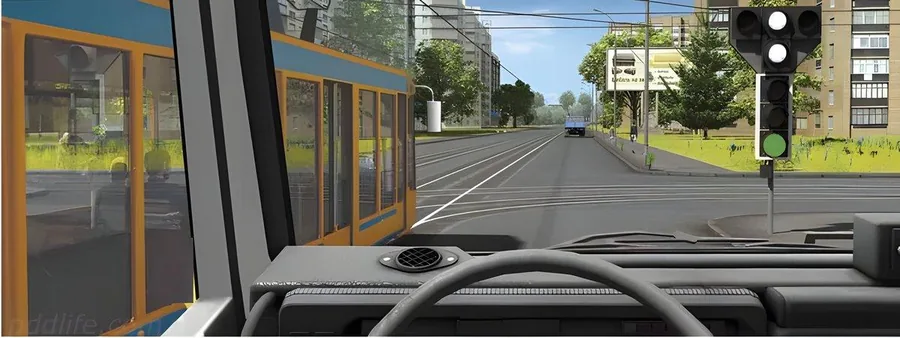
In which direction may the driver of a fixed-route bus proceeding in a designated lane travel in this situation?
1
Straight ahead only.
(Correct answer)
2
In all directions.
178
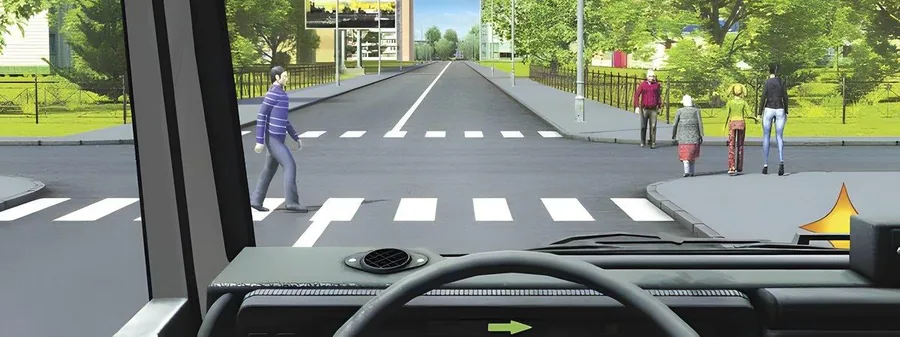
A bus driver must not interfere with:
1
Only pedestrians crossing at a pedestrian crossing.
2
Only pedestrians encountered while making a turn.
3
All pedestrians.
(Correct answer)
179
When making a right or left turn and leaving the intersection, a bus driver must:
1
Not interfere with pedestrians crossing the roadway.
2
Yield to bicyclists proceeding on a bicycle path.
3
Comply with both requirements.
(Correct answer)
180
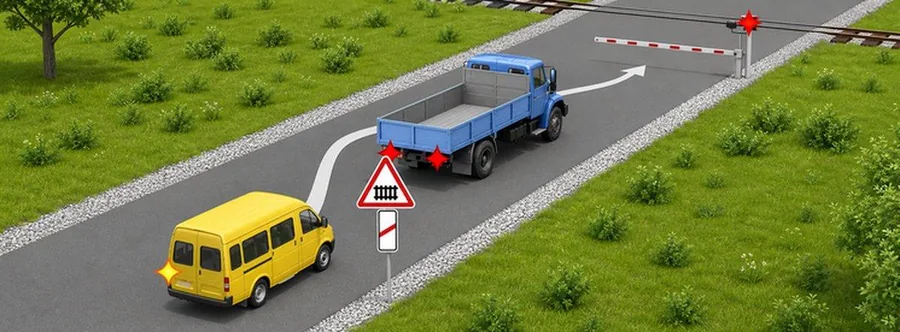
Is a bus driver permitted to drive around the truck by entering the oncoming traffic lane?