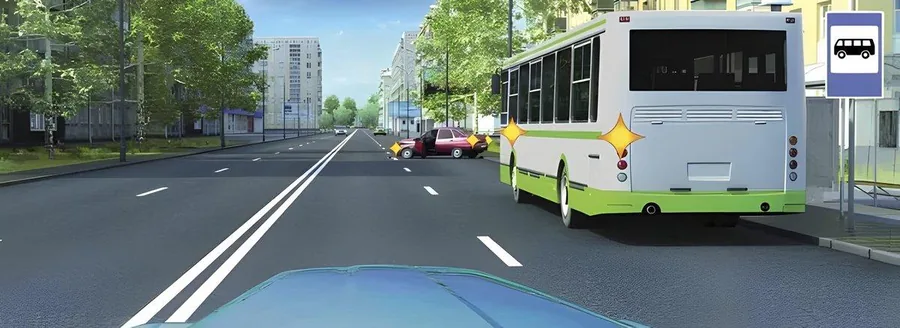
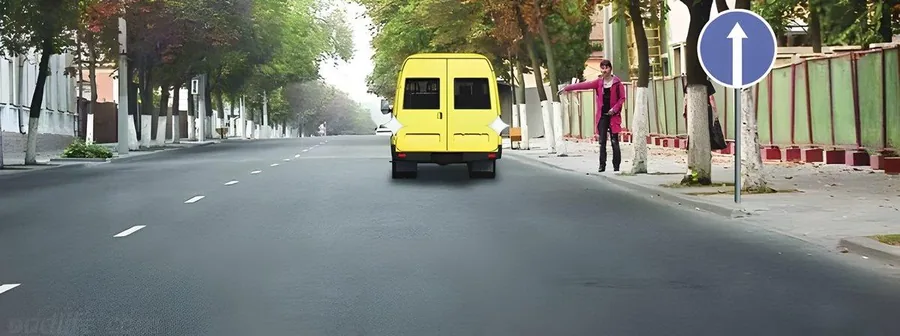
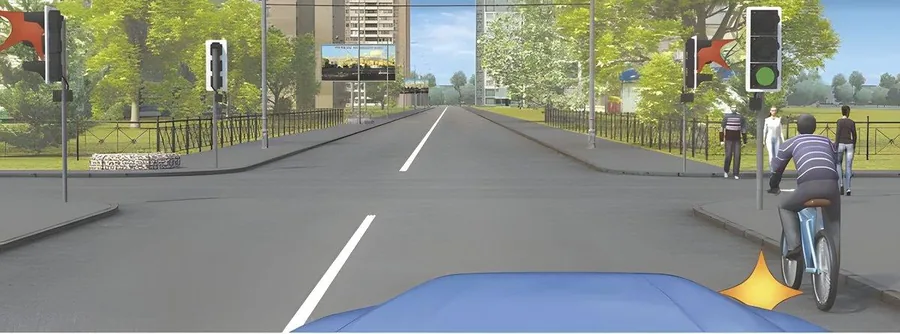
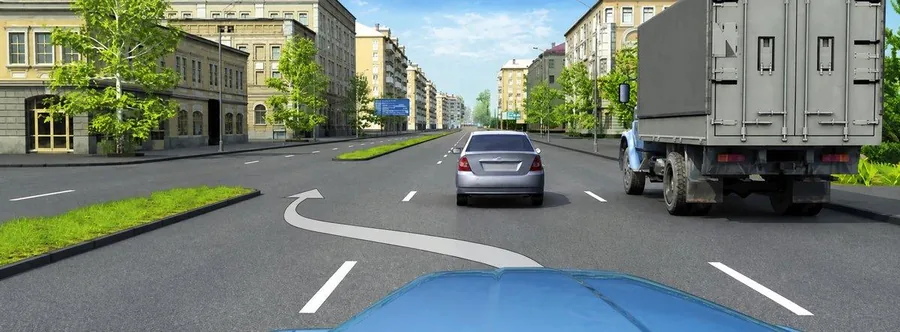
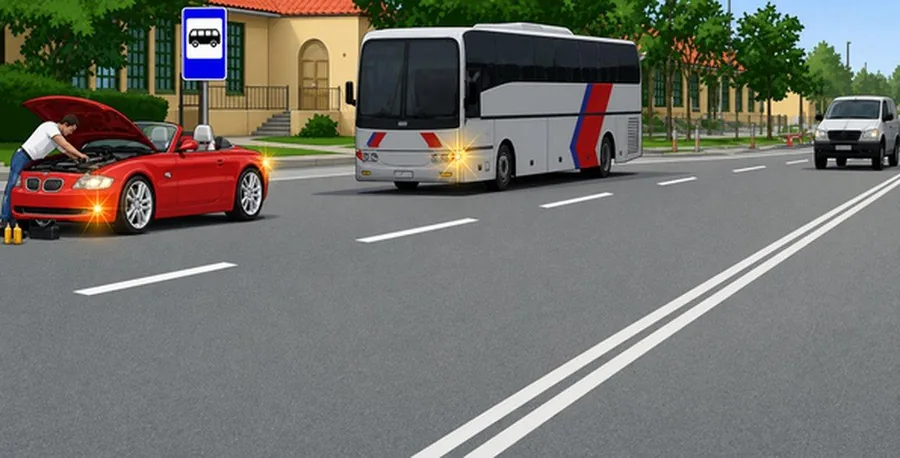
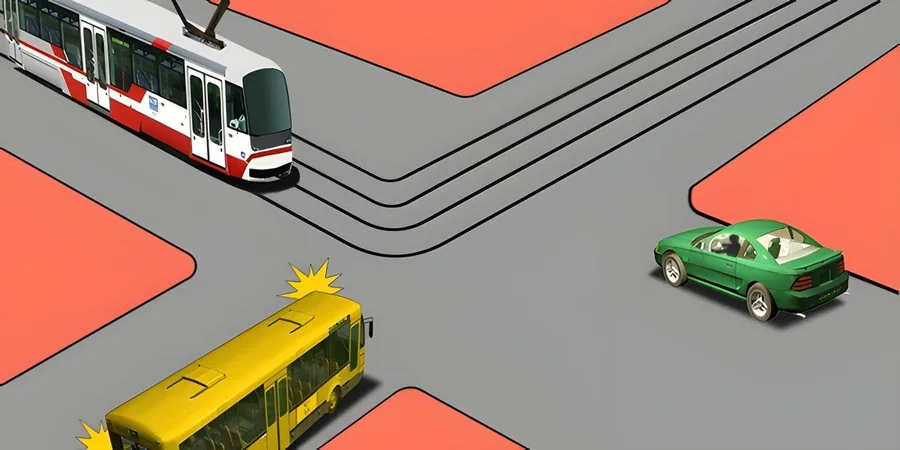
In this situation, must the driver of an intercity bus yield to the driver of a fixed-route bus starting to move?
-
Yes.
(Correct answer)
-
No.
Reversing in this situation is:
-
Prohibited.
-
Permitted.
(Correct answer)
-
Permitted only for bus drivers.
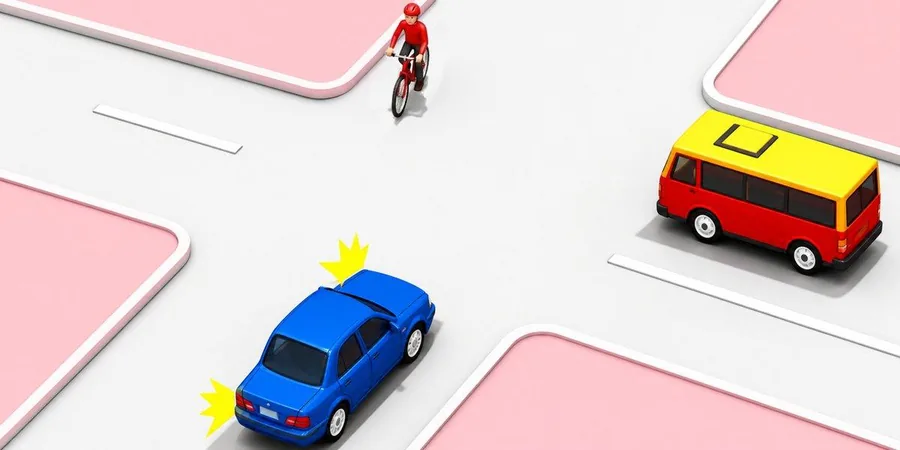
In this situation, the driver of a public transit vehicle:
-
Has the right-of-way only over the bicyclist.
-
Has the right-of-way over the bicyclist and pedestrians.
-
Must yield to the bicyclist and must not interfere with pedestrians.
(Correct answer)
Outside populated areas, must drivers yield to public transit vehicles starting to move from designated and marked stopping places?
-
Yes.
-
No.
(Correct answer)
At an intersection of equivalent roads, a tram operator must yield to:
-
Drivers of all vehicles approaching from the right.
-
Only tram operators approaching from the right.
(Correct answer)
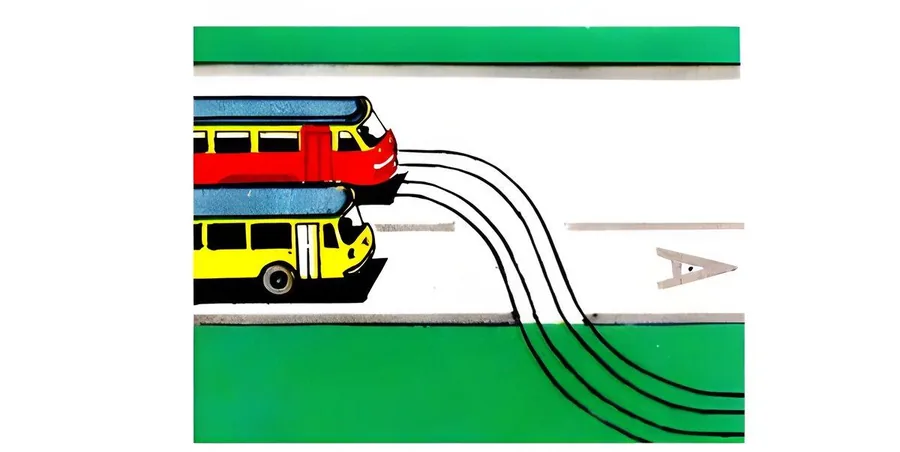
A bus driver proceeding along the indicated path is:
-
Prohibited.
-
Permitted only when passing.
-
Permitted only when making a U-turn or left turn.
(Correct answer)
Must a tram yield to a bus proceeding along a fixed route?
-
Must yield.
-
Not required.
(Correct answer)
On all roads with four lanes in the same direction, are public transit vehicles permitted to occupy the leftmost lane?
-
Permitted when passing.
-
Permitted when making a left turn or U-turn.
(Correct answer)
-
Permitted in all cases.
In this situation, must the driver of the fixed-route bus yield to the passenger car before starting to move?
-
Not required.
(Correct answer)
-
Must yield.
What is the maximum permitted speed for tourist buses on motorways?
-
70 km/h.
-
90 km/h.
(Correct answer)
-
100 km/h.
-
110 km/h.
If the traffic controller’s arms are extended to the sides, which public transit vehicle is permitted to proceed straight ahead only?
-
Buses only.
-
Buses and trolleybuses.
-
Trams only.
(Correct answer)
-
All of the listed vehicles.
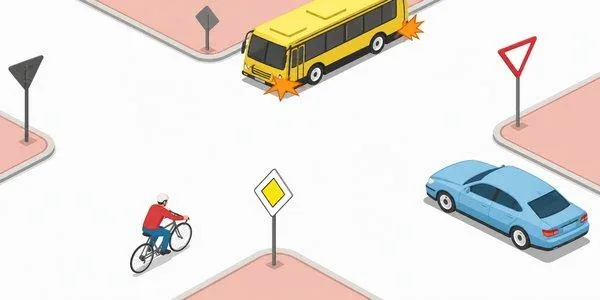
Must a bus driver yield to the bicyclist?
-
Must yield.
(Correct answer)
-
Not required if the bus is a fixed-route bus.
-
Not required if the bus is large and is proceeding straight ahead.
Must a bus driver yield to the bicyclist?
-
Not required if the bus is large.
-
Not required if the bus is a fixed-route bus.
-
Must yield.
(Correct answer)
Must a bus driver yield to the tram?
-
Not required because the bus is approaching the tram from the right.
-
Must yield.
(Correct answer)
If a bus driver has entered an intersection on a permissive traffic signal, then:
-
Regardless of the traffic signals, the driver must stop.
-
If a stop line pavement marking is present, the driver must comply with every traffic-signal indication.
(Correct answer)
Before making a turn or U-turn, a bus driver must occupy the corresponding outermost lane in advance, except:
-
When making a U-turn at an intersection.
-
When making a right turn if this does not interfere with other vehicles.
-
When the driver is unable to do so because of the vehicle’s dimensions or for other reasons.
(Correct answer)
At intersections of equivalent roads, which public transit vehicle has the right-of-way?
-
Public transit buses only.
-
Trams and trolleybuses.
-
Trams only.
(Correct answer)
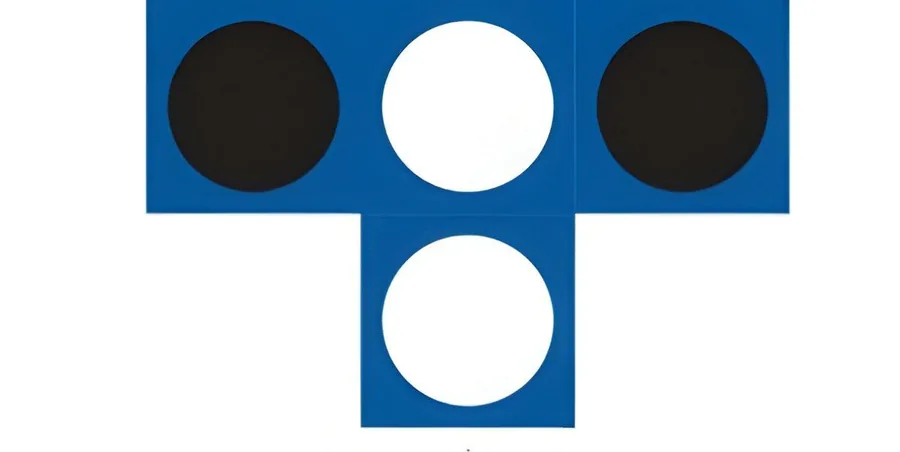
With this traffic-signal indication, tram traffic:
-
Is permitted to the right or left.
-
Is permitted in all directions.
-
Is prohibited.
(Correct answer)
For a public transit bus proceeding in a designated lane, traffic is prohibited:
-
For making a U-turn.
-
For turning right, turning left, and making a U-turn.
-
In all directions.
(Correct answer)
In which direction is a public transit bus proceeding in a designated lane permitted to travel?
-
To the right and left only.
-
Straight ahead only.
(Correct answer)
-
In all directions.